
Uffizi Gallery
Skip-the-line Tickets
By booking this ticket, it is possible to visit the Uffizi Gallery by entering through a door dedicated to visitors with reservations and avoid long waits at the ticket office.
Buy Tickets
Leonardo Da Vinci at the Uffizi Gallery
Leonardo da Vinci at the Uffizi Gallery in Florence, let's discover together the 3 masterpieces of the Tuscan genius!
Leonardo da Vinci, Tuscan by birth, has spent most of his life traveling around Italy. Many of his masterpieces are therefore scattered in various Italian cities of art or in the largest museums in the world. However, the Uffizi Gallery also boasts 3 of his masterpieces. Let's see what are the paintings of Leonardo da Vinci at the Uffizi Museum.
In reality only two paintings are the exclusive work byLeonardo, the fascinating Annunciation and the large altarpiece with the Adoration of the Magi remained unfinished, while the third, the Baptism of Christ, is a work from the Verrocchio workshop. The young Leonardo studied in Verrocchio's workshop and participated in the realization of this work by painting the angel on the far left and other details.
To be fair, Leonardo da Vinci's work at the Uffizi Gallery does not end with these 3 masterpieces. In the Cabinet of Drawings and Prints of the Uffizi it is in fact possible to admire a beautiful drawing by Leonardo dated 1473 depicting a landscape that represents a view of Montalbano and the castle of Montevettolini.
Leonardo da Vinci at the Uffizi Gallery: room 35
The genius of Leonardo da Vinci is celebrated at the Uffizi which dedicates an entire room to him on the second floor of the gallery, number 35, constantly besieged by thousands of tourists every day. Like few others, in fact, Leonardo remains an artist of such prestige and interest for any visitor.
Leonardo's Annunciation in the Uffizi
The Adoration of Leonardo is one of the best known works of the Tuscan genius. It is a large painting measuring 98 cm by 217 cm wide, a painting made with tempera mixed with oil on wood. The commissioning of the large painting is uncertain as well as the dating. However, it seems that the work was created by a Leonardo in his early twenties.
The subject is the classic annunciation of the angel to the Virgin. The sacred event seems to be located at dawn, probably Maria is just outside her room of which you can barely see a detail on the far right of the painting. Maria is an aristocratic lady, dressed in luxurious Renaissance clothes, the context is equally aristocratic, the details of the wall behind the Madonna make one think of a noble palace, as well as the well-kept garden and the richly decorated table on which Mary's lectern rests.
The background landscape is very bright, typical of the Tuscan countryside, in the background you can in fact see the Tuscan hills, some cypresses, perhaps a city overlooking the sea and a horizon that fades delicately towards high blue rocky mountains that are lost in the background and merge with clear clouds in the sky.
The lawn is littered with a variety of flowers and herbs. Also in the background a strange tree strikes, which initially made one think of oriental references. Instead, it is an example of topiary art typical of the time and of the most richly decorated Renaissance gardens.
The scene is in progress, the angel speaks to Mary who listens to him with a rather calm expression, absolutely not frightened, while the wind blows, moving the flowers of the meadow. Even the pages of the book are moving, it is the Madonna who with her hand gesture is turning the pages that the artist makes read almost transparent and in motion. The clothes of the Madonna and the angel are cared for in every fold and detail. The eye is struck by the disproportion of Mary's arm that leafs through the pages of the book which is too large compared to the rest of the woman's body. Undoubtedly wanted by the artist, this artifice was created by Leonardo with a specific purpose. The disproportion seems to disappear if the visitor places himself at the bottom right of the painting. This was in fact the position in which the observer presumably had to be.
The Adoration of the Magi by Leonardo in the Uffizi
This extraordinary large work (246x243 cm) remained unfinished. It was made around 1481 with the same technique as the Annunciation, tempera mixed with oil on wood. It arrived at the Uffizi as early as 1670 from the personal collection of Antonio and Giulio de 'Medici. It was moved to the Medici villa of Castello for a certain period and finally returned to the Uffizi in 1794.
Leonardo was unable to finish this work, which remained almost totally monochromatic, because the artist suddenly left for Milan in 1482. The Augustinian monks who commissioned the painting were therefore forced to replace the altarpiece by one made by Filippino Lippi.
The work has recently been restored, the restoration has revealed some details previously not visible due to dirt and paints applied later.
The altarpiece depicts in the center the adoration of the Magi at the birth of Jesus, a grandiose scenario populated by men and animals, symbols. In the painting, particularly in the background, however, several interlinked episodes follow one another. The face of the Madonna is barely mentioned while the powerful and characterized expressions of some characters whose faces have practically been completed are of great impact.
The Baptism of Christ by Leonardo and Verrocchio
As already mentioned, Leonardo da Vinci's third work in the Uffizi Gallery is the Baptism of Christ, a work in which Leonardo participated in the execution but which comes from the workshop of his master Verrocchio. The work comes from the monastery of San Michele a San Salvi in Florence. Verrocchio's workshop was undoubtedly one of the most active of the Renaissance in the city and the young Leonardo is here learning the art of painting to surpass the master. In fact, it is said that Verrocchio stops painting when he realizes that his pupil Leonardo had passed him. From that moment Verrocchio will devote himself to the other arts in which he certainly excelled including sculpture and goldsmithing.
In the Uffizi painting the sublime hand of Leonardo can be recognized in the figure of the angel on the far left of the scene and in the landscape in the background. The contributions of other artists are noted in the painting. Behind the Baptist, for example, the rocks and trees are much harder in execution and contrast with the sweetness of the nuances of the mountains and the landscape that can be glimpsed behind the angels. The body of Christ is also smooth and soft, while that of the Baptist is harsh and taut.
The other works of Leonardo in Florence
There aren't many other works by Leonardo da Vinci to see in the city of Florence. For true enthusiasts it is possible to visit the museum entirely dedicated to Leonardo, especially focused on his machines and his projects. The museum is located in Via de Servi, therefore not far from the Uffizi and a few steps from Piazza del Duomo.
Finally, Leonardo in Florence was engaged for some time in the design and construction of a fresco for the walls of the hall of the Cinquecento in Palazzo Vecchio that was supposed to depict the Battle of Anghiari. Only Leonardo's preparatory drawings remain of this painting. In fact, the execution of the work was interrupted due to technical problems related to the application of the color and was then covered and replaced by other decorations.
To admire the works of Leonardo da Vinci in Florence, it is therefore advisable to visit the Uffizi Gallery and in particular room 35 of the museum!


Magazine
Scopri di più
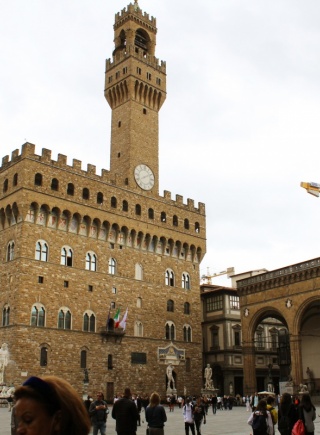 Piazza della Signoria in Florence and the fountain of Neptune
Piazza della Signoria is a real treasure chest of art treasures, in the heart of historic Florence.This famous Florentine square is home fir...
Read More
Piazza della Signoria in Florence and the fountain of Neptune
Piazza della Signoria is a real treasure chest of art treasures, in the heart of historic Florence.This famous Florentine square is home fir...
Read More
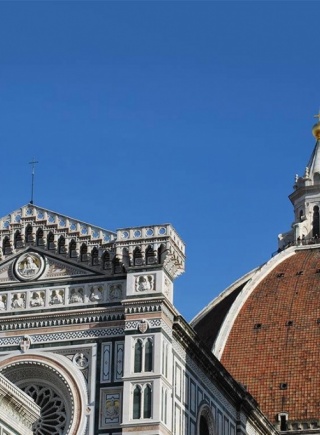 The Duomo of Florence, Santa Maria del Fiore Cathedral
The Cathedral of Santa Maria del Fiore is the fifth largest church in Christianity."Duomo" is a word that derives from the Latin "domus", or...
Read More
The Duomo of Florence, Santa Maria del Fiore Cathedral
The Cathedral of Santa Maria del Fiore is the fifth largest church in Christianity."Duomo" is a word that derives from the Latin "domus", or...
Read More
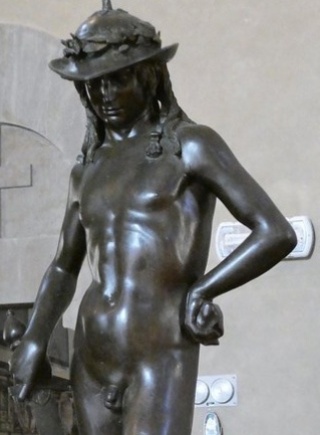 The Bargello Museum and Donatello's David
The Bargello National Museum is one of the most important Italian museums and houses masterpieces by Michelangelo, Ghiberti, Cellini, Giambo...
Read More
The Bargello Museum and Donatello's David
The Bargello National Museum is one of the most important Italian museums and houses masterpieces by Michelangelo, Ghiberti, Cellini, Giambo...
Read More
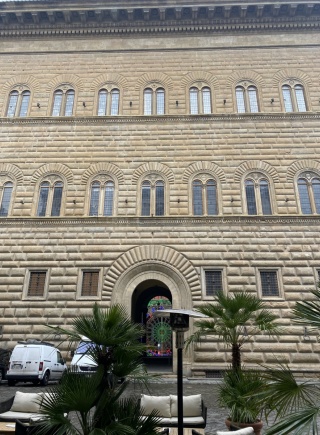 Palazzo Strozzi in Florence a timeless jewel
Palazzo Strozzi has three grandiose identical portals facing Via Tornabuoni and Piazza Strozzi. The palace was commissioned by Filippo Stroz...
Read More
Palazzo Strozzi in Florence a timeless jewel
Palazzo Strozzi has three grandiose identical portals facing Via Tornabuoni and Piazza Strozzi. The palace was commissioned by Filippo Stroz...
Read More
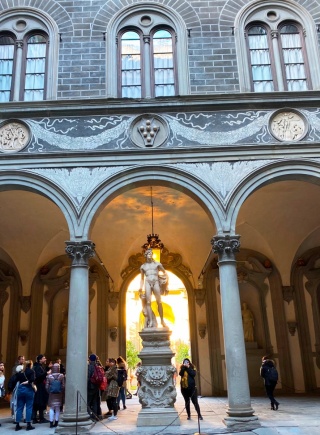 Palazzo Medici Riccardi in Florence the first Medici residence
The Medici Riccardi palace is located in the heart of Florence and is a work created by the architect Michelozzo, commissioned by Cosimo the...
Read More
Palazzo Medici Riccardi in Florence the first Medici residence
The Medici Riccardi palace is located in the heart of Florence and is a work created by the architect Michelozzo, commissioned by Cosimo the...
Read More
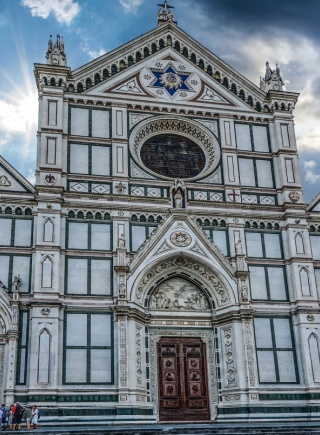 Santa Croce Basilica in Florence
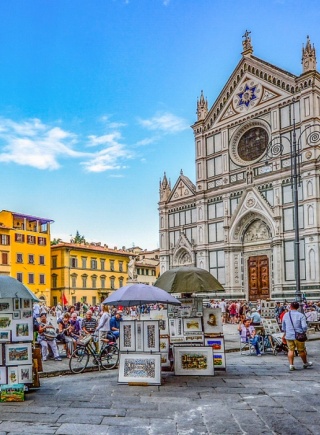
The Santa Croce Basilica is located in the homonymous square in the heart of Florence. It is one of the largest Franciscan churches and undo...
Read More
Santa Croce Basilica in Florence
The Santa Croce Basilica is located in the homonymous square in the heart of Florence. It is one of the largest Franciscan churches and undo...
Read More
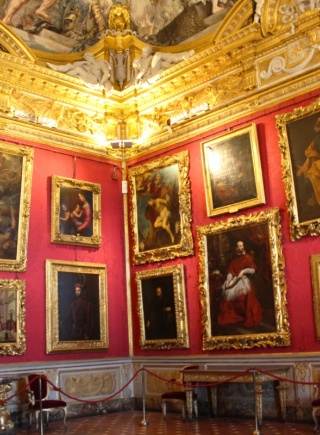 Palazzo Pitti in Florence and the Palatine Gallery
Palazzo Pitti was the palace of the Grand Duchy of Tuscany under the dynasty of the Medici family previously and the Lorraine later.Inside t...
Read More
Palazzo Pitti in Florence and the Palatine Gallery
Palazzo Pitti was the palace of the Grand Duchy of Tuscany under the dynasty of the Medici family previously and the Lorraine later.Inside t...
Read More
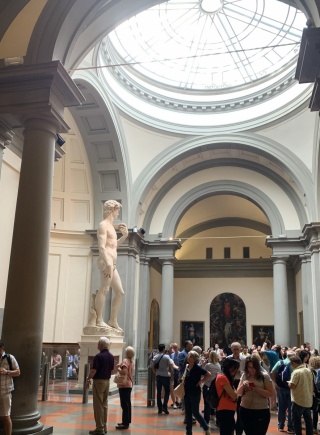 Michelangelo's David at the Academy of Florence
Michelangelo's David is an imposing sculpture in Carrara marble still considered the perfect ideal of a male figure. It is certainly made ar...
Read More
Michelangelo's David at the Academy of Florence
Michelangelo's David is an imposing sculpture in Carrara marble still considered the perfect ideal of a male figure. It is certainly made ar...
Read More
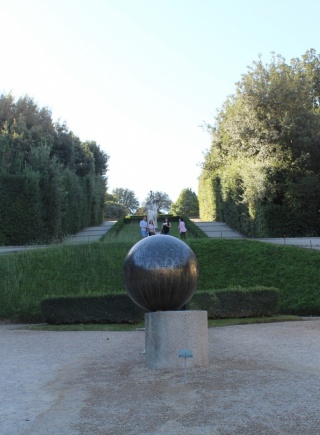 The Boboli Gardens in Florence and its wonders
The Boboli Gardens covers an area of 45,000 square meters on the hill behind Palazzo Pitti and continues down towards Porta Romana, passin...
Read More
The Boboli Gardens in Florence and its wonders
The Boboli Gardens covers an area of 45,000 square meters on the hill behind Palazzo Pitti and continues down towards Porta Romana, passin...
Read More
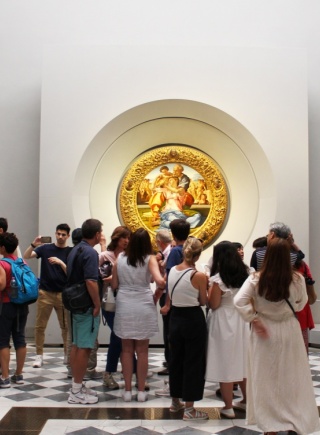 The Uffizi Gallery, the history of the largest Renaissance museum
The Uffizi Museum houses one of the most important Renaissance art collections in the world, Botticelli, Cimabue, Caravaggio, Giotto, Michel...
Read More
The Uffizi Gallery, the history of the largest Renaissance museum
The Uffizi Museum houses one of the most important Renaissance art collections in the world, Botticelli, Cimabue, Caravaggio, Giotto, Michel...
Read More
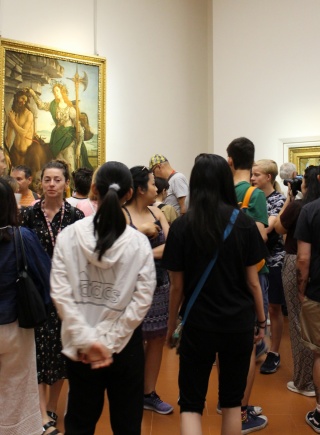 Sandro Botticelli at the Uffizi Gallery of Florence
The Uffizi Gallery is one of the most important museums in the world, but also the Museum of Sandro Botticelli!The Uffizi museum is based in...
Read More
Sandro Botticelli at the Uffizi Gallery of Florence
The Uffizi Gallery is one of the most important museums in the world, but also the Museum of Sandro Botticelli!The Uffizi museum is based in...
Read More
 Read More
 Read More
 Read More
 Read More
 Read More
 Read More
 Read More
The Uffizi Gallery houses the largest collection of paintings from Romanesque period to the 18th century. Nowadays the Uffizi still accommodates famous masterpieces exhibited in chronological order